Immersive Learning. Real-World Success.
At ABA STEPS, we are committed to combining compassionate, evidence-based ABA with innovative technology that helps participants develop meaningful skills for everyday life. One of the ways we do this is through our Virtual Reality (VR)-Enhanced ABA Program using Floreo®, an immersive learning platform designed specifically for neurodiverse learners.
Floreo allows participants to safely practice social, communication, emotional regulation, community safety, executive functioning, and daily living skills inside realistic virtual environments while being actively coached by one of our trained ABA providers. Rather than replacing traditional ABA, Floreo enhances it by creating opportunities to practice difficult-to-teach skills in engaging, repeatable, and highly individualized settings.
How Virtual Reality Fits into ABA STEPS' Clinical Model
Our Virtual Reality program follows the same compassionate philosophy that guides every service we provide. Whether a participant is working with an RBT or BCBA, instruction continues to be grounded in PFA-SBT, trauma-informed care, and assent-based treatment.
The technology simply becomes another teaching tool.
Just as we individualize play, natural environment teaching, or community instruction, we individualize each VR experience based on the participant’s treatment goals, learning style, communication abilities, and readiness to participate.
What Happens During a VR Session?
Every VR session is carefully planned and supervised by an ABA provider.
Before entering the virtual environment, the provider prepares the participant by reviewing expectations, selecting an individualized lesson, and ensuring the participant is comfortable with the equipment. Participation is always voluntary, and providers continuously monitor assent throughout the experience.
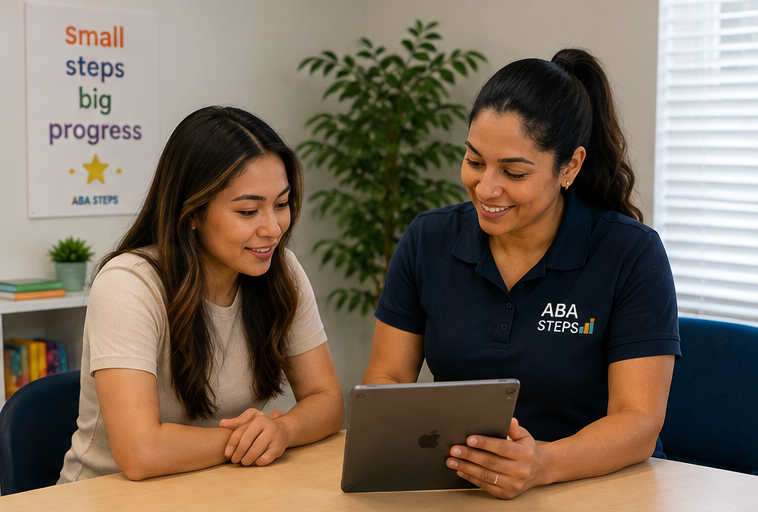
The participant then wears the VR headset while the provider connects through Floreo’s Coach interface on a computer or tablet. Unlike traditional virtual reality experiences, the provider sees exactly what the participant is seeing in real time and actively guides the lesson as it unfolds.
Throughout the lesson, the provider:
- Delivers prompts, coaching, and encouragement.
- Models appropriate responses.
- Provides immediate reinforcement.
- Adjusts support based on the participant’s performance.
- Monitors engagement and emotional regulation.
- Individualizes instruction using ABA teaching procedures.
- Collects performance data throughout the lesson.
The Coach interface also provides guided teaching opportunities, suggested coaching language, and progress tracking, allowing providers to deliver consistent, individualized instruction while maintaining flexibility based on each participant’s needs.
Learning Beyond the Headset
The virtual lesson is only one part of the teaching process.
After completing each experience, providers immediately help participants process what they learned through discussion, role-play, natural environment teaching, and practice across clinic, home, school, or community settings whenever appropriate.
This step is essential because our goal is not simply to perform well in virtual reality—it is to build skills that generalize to everyday life.
Providers review lesson data, identify strengths and areas for growth, and use those results to guide future programming. Because lessons can be repeated as often as needed in a predictable environment, participants can gradually build confidence before practicing the same skills in real-world situations.
Skills We Teach
Floreo’s growing library allows our clinicians to target individualized treatment goals in areas such as:
- Social communication and conversation
- Emotional awareness and regulation
- Perspective taking
- Friendship and peer interactions
- Community safety
- Crossing streets safely
- Grocery shopping and community navigation
- Restaurant and public interactions
- School readiness
- Classroom participation
- Executive functioning
- Flexibility and coping with unexpected changes
- Daily living and independent living skills
- Interview skills, soft employment skills, and many more
Each lesson is selected because it supports goals already identified within the participant’s ABA treatment plan.
Why We Chose Floreo
When evaluating virtual reality platforms for our participants, ABA STEPS selected Floreo® because it is one of the few virtual reality systems developed specifically for neurodiverse individuals and designed to be used in partnership with trained clinicians. Unlike general VR applications, Floreo was built to support individualized instruction, real-time provider coaching, data collection, and skill generalization within evidence-based behavioral and educational practices.
Another factor that influenced our decision was Floreo’s recognition by the U.S. Food and Drug Administration (FDA). Floreo has received the FDA’s Breakthrough Device Designation, a designation granted to medical technologies that have the potential to provide more effective treatment or diagnosis for serious conditions. While this designation is not the same as FDA approval, it reflects that the technology has undergone FDA review and was determined to meet the program’s criteria for addressing an important unmet clinical need. The designation also allows Floreo to work more closely with the FDA throughout the evaluation process as research continues.
In addition to its growing body of research, Floreo provides our clinicians with hundreds of immersive learning experiences targeting social communication, emotional regulation, executive functioning, community safety, and daily living skills. Its unique coach interface enables providers to view exactly what the participant is seeing, deliver prompts and reinforcement in real time, monitor progress, and adjust instruction based on each participant’s individual needs.
Most importantly, Floreo aligns with ABA STEPS’ philosophy of compassionate, individualized care. It supports the relationship between the participant and provider rather than replacing it, allowing us to combine innovative technology with our PFA, Skill-Based Treatment (SBT), Positive Life Skills (PLS), trauma-informed, and assent-based approach to help participants develop meaningful skills that transfer confidently into everyday life.